
A practical comparison of AI chatbot and live chat for response speed, complex questions, staffing, cost and customer experience.

Businesses searching for AI chatbot vs live chat usually already know the technology exists. The practical question is how to use it without adding risk or unnecessary work. This guide organises the decisions that matter before you buy or launch.
Why this decision matters
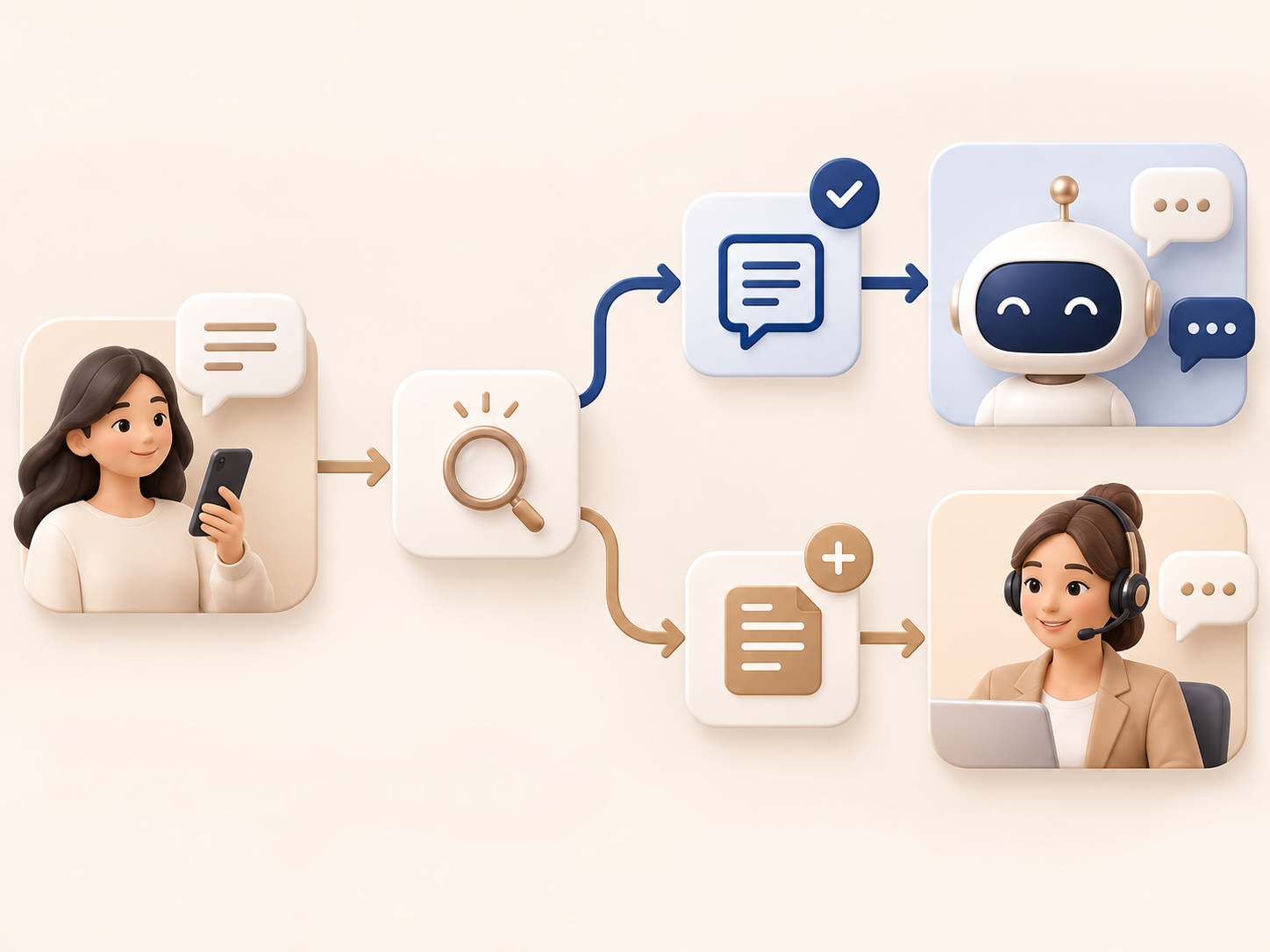
Live chat gives visitors a real person, but only while someone is available. An AI assistant replies instantly and handles repeated questions at scale, but it still needs clear boundaries and a route to a person. Many businesses get the best result by combining both.
What to check before you decide
expected response time during and after opening hours
share of repeated versus complex questions
team capacity and peak-time coverage
handoff rules for sales, complaints and sensitive cases
During a demo, do not only check whether the assistant can talk about expected response time during and after opening hours. Ask how that answer is updated, who receives the outcome and what happens when the conversation reaches handoff rules for sales, complaints and sensitive cases. This shifts the evaluation from a polished demonstration to daily operation.
A practical example
A clinic can let the assistant answer prices, opening hours and preparation questions, then hand a visitor to staff for a special medical or scheduling case. A B2B company can qualify the request first and route only sales-ready leads to live chat.
The useful pattern is progressive assistance. The assistant provides value first, then asks only for information needed for the next step. This can produce a shorter conversation, a clearer customer journey and a more useful handoff for the team.
How to get started
Group the last 100 questions by complexity.
Choose which topics the assistant may answer on its own.
Write visible handoff rules and response-time expectations.
A common mistake is giving the first version too many jobs. When the goal, source and owner are unclear, it becomes difficult to tell whether weak results come from the technology or the process. A narrow, measurable launch produces reliable learning sooner.
What to measure in the first month
Compare first-response time, resolution rate, handoff rate and customer satisfaction. If visitors repeatedly ask for a person immediately, improve the opening message and make the limits clearer.
Want to see how this would work on your own website? Request a personalised Enéh demo: https://eneh.hu/demo/request.
See it working
Seven industry demo sites, each with a trained Enéh assistant on it — ask them anything.
Browse the demosKeep reading

How Much Does an AI Chatbot Cost in 2026? Pricing Models and Hidden Costs
Compare AI chatbot pricing models, setup fees, usage costs and the hidden work that determines the real first-year price.

Same facts, your voice: 40 characters and automatic languages
A pizzeria and a law firm shouldn’t sound the same. Enéh lets you choose how your assistant talks — formal or casual, a name of your own, or...

Why Enéh says “I don’t know” — and why that’s its most important feature
A chatbot that confidently invents a price costs you more than one that says nothing. Here is how Enéh keeps every answer tied to what you a...

Nonprofits and foundations: stories that end in a donation, not a dead end
A nonprofit’s website is full of stories, but rarely tells a moved visitor what to do next. Enéh’s nonprofit mode tells your campaign storie...